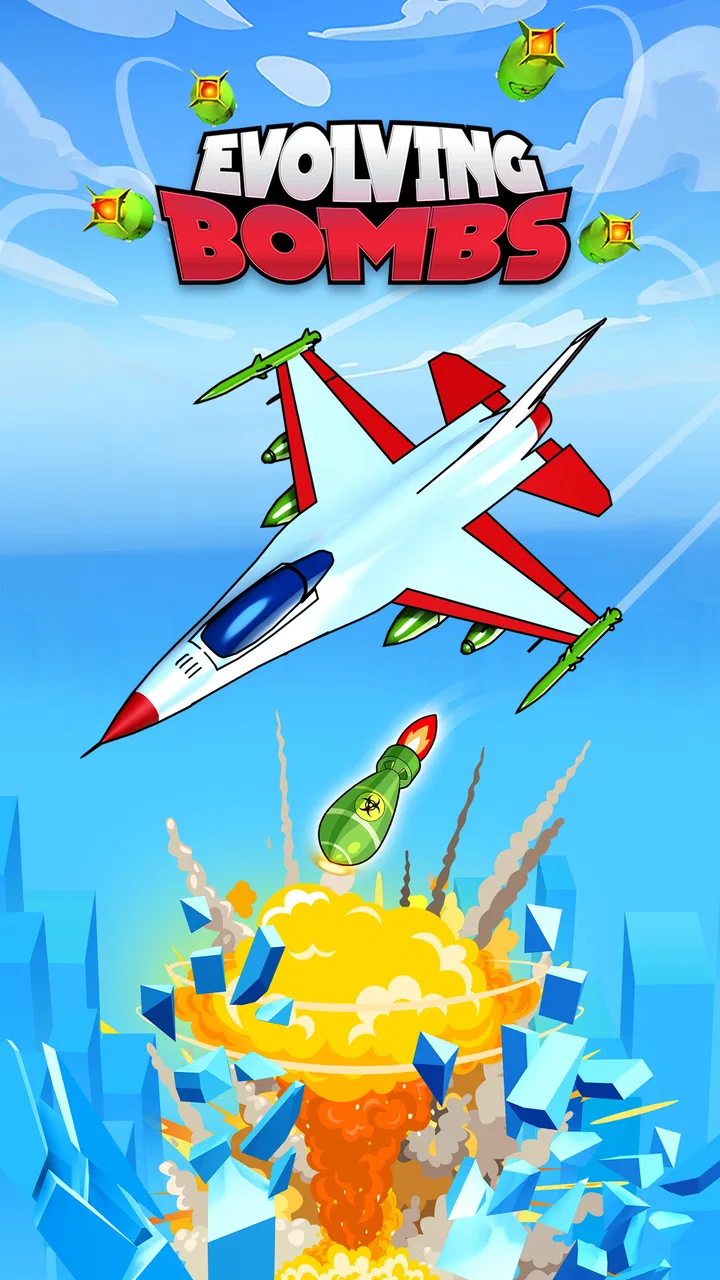
Evolving Bombs!
- 4.1
- Rating
- 10.00M
- Installs
- Free
- Price

 Analysis by App-foxy
I spent time with Evolving Bombs as a quick-action mobile game, and my first impression was that it understands the appeal of a simple idea: guide a warplane, aim a bomb with a slingshot-style gesture, and enjoy the impact when the timing works. It is made by CrazyLabs LTD, sits in the action category, and is free to download. That combination makes it easy to try, but the real question is whether its short, explosive encounters offer enough variety to keep you coming back.
My answer is a qualified yes. I found it most enjoyable in brief sessions when I wanted something immediate rather than a deep campaign or a realistic flight simulator. The controls are built around quick decisions, and the bomb-launching mechanic gives each attempt a small moment of tension. It is not trying to be a serious aviation game. Instead, it turns aerial attacks into compact challenges where positioning, timing, and the satisfaction of a well-placed hit matter more than technical realism.
How the free entry point affects the experience
The basic cost is straightforward: the game is free to download and play, while optional in-app purchases range from $0.99 to $39.99 per item. That makes the initial decision easy because you can test the core loop without paying first. I would still approach the purchase screen carefully. A free download is useful here because the game’s appeal depends heavily on whether you enjoy repeating short bombing attempts, not simply on whether the store summary sounds entertaining.
You May Also Like

 Blood Strike: 2.5 Anniversary
Blood Strike’s Loadouts Turn Every Drop Into a Tactical Gamble
A close look at Blood Strike’s custom loadouts: how fast access to signature weapons reshapes its battle royale rhythm, rewards preparation, and narrows the gap between fights.

 Pandora - Music & Podcasts
Pandora’s Music Is Easy to Start, but Harder to Recover
Pandora’s strength is its low-effort path from a seed to a station. Its weak spot is how much confidence it asks you to place in connection, setup, and quiet recovery.

 8 Ball Pool
 Is Built on Rivalries, Rematches, and Routine
A close look at the rivalries, rematches, shared routines, and unanswered safety questions that turn a quick pool match into a persistent mobile community.

 Samsung Music
’s Quiet Strength Is Playing What You Already Own
Its reach comes less from spectacle than from dependable access to a personal library. That simplicity is both the app’s strongest retention engine and its ceiling.

 AccuWeather: Weather Radar
AccuWeather Review: A Quick, Clear Forecast for Everyday Decisions
For everyday plans, the best forecast is the one you can understand quickly. AccuWeather makes rain timing, radar, and local conditions easy to act on, with a few trade-offs.

 Hill Climb Racing
Why Hill Climb Racing Still Turns Crashes Into One More Run
A tiny car, a bumpy hill and one more upgrade: Hill Climb Racing keeps resurfacing because its simple chaos makes every near-miss feel personal.
More From Our News Desk



The Teen content rating is also worth keeping in mind. The focus is cartoon-style aerial action and explosive attacks, so this is better suited to players who are comfortable with that tone than to young children looking for a gentle puzzle game. The rating does not make it a military simulation, but it does signal that the presentation is built around combat and destruction rather than harmless abstract shapes.
The current version is 7.9.0.0, and the game runs on devices using Android 7.0 or later. That compatibility makes it accessible on a broad range of Android phones, although actual comfort will still depend on the device’s screen, responsiveness, and how smoothly it handles the action. I would use a stable connection when checking any purchase-related screen or game content that depends on the live app environment, rather than assuming every part of the experience will behave identically offline.
What I appreciate is that the free entry point lets you answer the important question through play: do you enjoy the repeated rhythm of lining up an attack, releasing the bomb, and seeing how effectively it lands? If that loop feels satisfying after several sessions, optional spending may feel more understandable. If it already feels repetitive, paying more is unlikely to solve the underlying issue.
What the core play feels like
The central interaction is deliberately easy to understand. You lead the aircraft and use a slingshot-like motion to drop or launch bombs toward targets. That gives the game a different feel from a conventional side-scrolling shooter, where the main challenge is usually constant movement and rapid firing. Here, I found myself thinking more about the release moment and the angle of attack than about keeping a crosshair perfectly aligned.
That simplicity is a strength during short breaks. I could pick it up without needing to remember a complicated control scheme, and the explosive feedback makes even a small success feel clear. The game communicates its main idea quickly, which is exactly what I want from a casual action title on a phone.
The trade-off is that a simple control loop places a lot of pressure on progression and encounter design. When the main action is familiar, the surrounding challenges need to keep giving me a reason to adjust my approach. I noticed that the most interesting moments came when I had to resist dropping a bomb immediately and instead waited for a better position. That small delay can make the difference between a merely active turn and a satisfying one.
One useful habit is to treat each attempt as an observation exercise rather than rushing for the first available release. Watch how the plane’s position changes, identify where the target will be when the bomb reaches it, and then use the gesture with intention. This is a more reliable approach than repeatedly swiping as soon as the target appears. It also makes the game feel less random, because I am actively learning its timing instead of relying only on luck.
Where the value comes from
The value is not in a large amount of content that I can verify from the first launch. It comes from how well the game turns a single action into a repeatable challenge. A good round asks me to make a quick plan, commit to the gesture, and accept the result. That makes it suitable for a commute, a short wait, or a few minutes after finishing a task.
I also think the game works well for players who like tactile interactions more than traditional button-heavy controls. The slingshot motion gives the attack a physical quality, even though the underlying system is simple. It feels more involved than tapping a fire button, but it remains approachable enough that I did not need a tutorial session before understanding the basic objective.
Its audience is reflected in its reach: the game has passed 10 million installs, with an average rating of 4.0 from around 81 thousand ratings and about 2.8 thousand written reviews. Those figures suggest broad interest, but they should not be mistaken for a guarantee that it will suit every action fan. A large casual audience can enjoy a compact, repetitive loop, while players seeking deep strategy may find the same structure too light.
For me, the strongest value appeared when I used it as a reset between more demanding activities. After a long stretch of work, I did not want a complex story, a large map, or a long tutorial. I wanted a game that communicated its goal immediately and let me play in small bursts. The aircraft-and-bomb setup fits that use case better than a slower tactical game, especially when I only have a few spare minutes.
There is also a small skill-building benefit in paying attention to timing. The game encourages me to compare the result of an early release with a carefully delayed one, then change my next attempt. That is not deep strategy, but it is more engaging than pure button mashing. My advice is to focus on improving one decision at a time: first the release point, then the angle, then the choice of when not to attack.
The compromises behind the explosive simplicity
The biggest limitation is the risk of repetition. Because the main pleasure comes from aiming and dropping bombs, players who need a constantly changing set of mechanics may lose interest. I would not choose this as my main action game if I wanted a long-form campaign, character development, competitive depth, or realistic aircraft handling. Its concept is much narrower.
The gesture can also feel less precise than a traditional control layout. On a small screen, my finger can cover part of the action, and a release that feels almost identical to the previous one may produce a different result. When that happens, the game’s challenge can feel like a test of touch accuracy rather than a meaningful tactical decision. Using a larger screen and keeping my finger movement deliberate helped, but it did not remove the basic limitation of gesture-based play.
Another trade-off is the relationship between free access and optional purchases. The game costs nothing to start, which is a genuine advantage for curious players. However, the presence of purchases from $0.99 to $39.99 per item means I would not recommend spending impulsively just because progress slows or a particular item looks attractive. I would first establish whether I still enjoy the core bombing loop after repeated sessions. Paid value only makes sense if it improves a game I already like, rather than being used to persuade me to tolerate one I do not.
Players who dislike explosive themes should skip it even if they enjoy casual action games. The aircraft setting and bomb-focused mechanics are not a minor visual detail; they define the experience. Someone looking for a peaceful physics game, a construction title, or a racing game will find a better match elsewhere. Likewise, players who prefer long uninterrupted sessions may find the compact structure less rewarding than a conventional action adventure.
I would also avoid judging it by the standards of a flight simulator. The plane is a vehicle for the bombing challenge, not the subject of a detailed aviation experience. That is why the game can be picked up quickly, but it is also why aviation enthusiasts may want a different title with more control over navigation, aircraft behavior, and mission planning.
Practical ways to get more from each session
My first practical tip is to separate aiming from rushing. When a target is visible, the obvious reaction is to launch immediately. Instead, I found better results by watching the plane’s position for a moment and considering where the bomb will travel, not only where the target is right now. This turns the gesture into a prediction task and makes successful hits feel more earned.
Second, I recommend playing with a consistent grip. Changing how I held the phone made the same swipe feel different, especially when I was playing one-handed. A stable grip and a clear release point made it easier to learn from mistakes. This matters more in a game built around a single expressive gesture than it would in a simple tap-to-attack title.
Third, use short sessions as practice rather than treating every round as a final test. If an attempt goes badly, immediately repeating the same movement is not always useful. I got more from pausing briefly, identifying whether the problem was timing or angle, and then changing only one variable. That approach prevents frustration and helps reveal whether I am improving or merely repeating the same error.
For a daily scenario, imagine having a few minutes before an appointment. This is where I think the game makes the most sense: launch it, complete a handful of attacks, and stop without needing to remember a complicated story. If I had a longer evening free, I would probably choose a deeper action game instead. The short-session strength becomes less important when I want a richer sense of progress.
I would also keep purchase decisions separate from performance frustration. Missing a target can make an upgrade or paid item look tempting, but the better first response is to adjust the release timing and see whether the result improves. If the game remains enjoyable without spending, that is a stronger reason to consider optional purchases than a single difficult attempt.
How it compares with familiar action alternatives
Compared with a standard arcade shooter, this game gives aiming more importance than constant firing. That makes it calmer in one sense, because I am not always reacting to enemies, but more deliberate in another, because each release carries visible weight. Players who enjoy timing mechanics may prefer this structure, while fans of nonstop action may find it too measured.
Compared with a physics puzzle game, it has more movement and combat flavor. The goal is not simply to arrange objects or solve a static setup; the aircraft’s position and the bomb’s trajectory matter. Still, it does not offer the same kind of layered problem solving as a dedicated puzzle game. I see it as a middle ground: a quick action title with a light physics-like aiming element.
Compared with a flight game, it removes much of the complexity in favor of immediate impact. That is a benefit for casual players who do not want a cockpit, navigation controls, or lengthy missions. It is a weakness for anyone who wants to feel responsible for the entire flight. Choosing between them depends on whether the aircraft is your interest or simply the delivery system for the bomb mechanic.
Those comparisons helped me understand the game’s proper place. It is not a replacement for every action alternative. Its best quality is focus. It takes one recognizable fantasy—controlling an aircraft attack—and compresses it into a gesture-driven mobile loop. If that specific fantasy appeals to you, the simplicity is efficient. If you need broader systems, another genre option will provide better value.
Who should install it, and who should skip it
I would recommend trying it to casual action players who enjoy short rounds, clear objectives, and tactile aiming. It is especially suitable for someone who wants a free game to test during spare moments without committing to a large download experience or a complicated control system. The fact that it is available at no upfront cost makes that trial decision uncomplicated.
It may also suit players who enjoy gradually improving at a gesture. The game gives you a reason to refine how you release and when you commit, which can be satisfying if you like seeing small improvements in accuracy. It is a good fit for a player who enjoys repeating a compact challenge with a slightly better result each time.
I would suggest skipping it if your priority is a substantial narrative, detailed simulation, or a wide range of distinct mechanics. I would also be cautious if you are easily annoyed by repeated attempts or by optional purchase prompts in free mobile games. The purchase range is broad enough that setting a personal spending limit before playing is sensible.
Families should also consider the Teen rating before handing it to younger players. The game’s presentation is centered on warplanes and bombs, so it is not an all-ages substitute for a neutral puzzle or creative sandbox. That does not automatically make it unsuitable for every teenager, but it does make the content style part of the installation decision.
My final recommendation
After playing it, I see Evolving Bombs as a focused, free-to-start action game with a clear reason to exist. Its slingshot-style bombing mechanic is more distinctive than a basic tap shooter, and it works particularly well when I want a quick burst of interaction. The game delivers its best value through accessibility and short-session convenience, not through depth or simulation.
The main condition is that you should enjoy the central loop before considering any optional purchase. Free access gives you a fair chance to test that loop, while the available item prices make restraint important. I would play first, identify whether the timing challenge remains fun after the novelty fades, and only then decide whether spending adds enough value for my habits.
My verdict is to install it if you want compact aerial action and are comfortable with a Teen-rated, bomb-focused theme. I would skip it if you are searching for a realistic flight experience, a deep strategy game, or a long campaign. For the right player, it is an entertaining pick-up-and-play option; for everyone else, its narrow focus will be obvious quickly.
FAQs for Evolving Bombs!
01What is the main objective of Evolving Bombs!?
In Evolving Bombs!, the primary goal is to strategically manage and evolve your bombs to achieve maximum destruction. Players must navigate through various levels, each with unique challenges and targets. The game combines elements of strategy and puzzle-solving, requiring players to think ahead and adapt their tactics to succeed.
02Is Evolving Bombs! free to play?
Evolving Bombs! is free to download and play, but it offers in-app purchases. These purchases can enhance the gameplay experience by unlocking additional features, power-ups, or removing ads. While optional, these purchases can provide a more seamless and enriched gaming experience for players who choose to invest.
03What platforms is Evolving Bombs! available on?
Evolving Bombs! is available for both Android and iOS devices. Users can download the game from the Google Play Store for Android or the Apple App Store for iOS. The game is optimized to run smoothly on a variety of devices, ensuring a consistent experience across platforms.
04Are there any age restrictions for playing Evolving Bombs!?
Evolving Bombs! is rated for ages 9 and up, primarily due to mild cartoon violence and strategic gameplay elements. Parents should consider these factors when allowing younger children to play. It’s always advisable for guardians to review game content to ensure it aligns with their family’s media guidelines.
05Does Evolving Bombs! require an internet connection?
Evolving Bombs! can be played offline, making it convenient for users without a stable internet connection. However, certain features, like leaderboards and in-app purchases, require an internet connection to function. This allows players to enjoy the game anywhere while still accessing enhanced features when online.
Pros
- Engaging puzzle mechanics keep players hooked.
- Unique evolving bomb concept adds depth.
- Visually appealing with vibrant graphics.
- Smooth controls make gameplay intuitive.
- Regular updates with new levels and features.
Cons
- Ads can be intrusive during gameplay.
- Limited lives restrict playtime.
- In-app purchases are quite expensive.
- Requires constant internet connection.
- Some levels feel repetitively challenging.

Evolving Bombs!
Gallery